Research Projects
Our research is broadly centered around developing computational tools to map and control neural circuits, using those tools to discover neural ensembles that causally generate behavior, and building mechanistic models of how neural systems compute, learn, and perform inference.
Check out some of our ongoing projects below!
Computational methods for mapping and manipulating neural circuits
Major recent advances in optical neurotechnology now make it possible not only to record neural activity from the brain, but also to write custom neural activity patterns back into the brain in real time. This ability to precisely manipulate neural circuit activity has created exciting new opportunities to discover how circuits are wired up and probe how they implement neural computations.
To that end, we develop novel methods based on compressed sensing, causal inference, Bayesian nonparametrics, and related machine learning tools to optimize the throughput, accuracy, and interpretability of these circuit mapping experiments.
Our ultimate goal is to develop a computational platform for automated neural circuit mapping in the living brain, and use it to thereby understand how neural circuits are remodeled during learning and disease.
A custom pattern of neural activity (the letter “A”) written into the visual cortex of an awake mouse using two-photon holographic stimulation during calcium imaging. Recording from the Adesnik Lab.

Computational optimization of stimulus targeting can maximize the throughput of neural circuit mapping using holographic stimulation.
Mechanistic models of causal cognition
Causal reasoning is foundational to human cognition, shaping how we learn from observations, predict the effects of actions, and imagine counterfactual states of the world. Crucially, modern theories of causal cognition are formalized through causal graph structures, yet little is known about whether and how the brain actually uses such representations.
We’re building computational models to understand mechanisms of how neural circuits could generate internal representations of causal graphical structure during inference of causality from observation or intervention. Our work aims to bridge implementation-level circuit mechanisms with higher cognitive function to form testable experimental hypotheses. Then, through collaborations, we plan to test these theories in human intracranial studies in search of the neural basis of causal cognition in the brain.
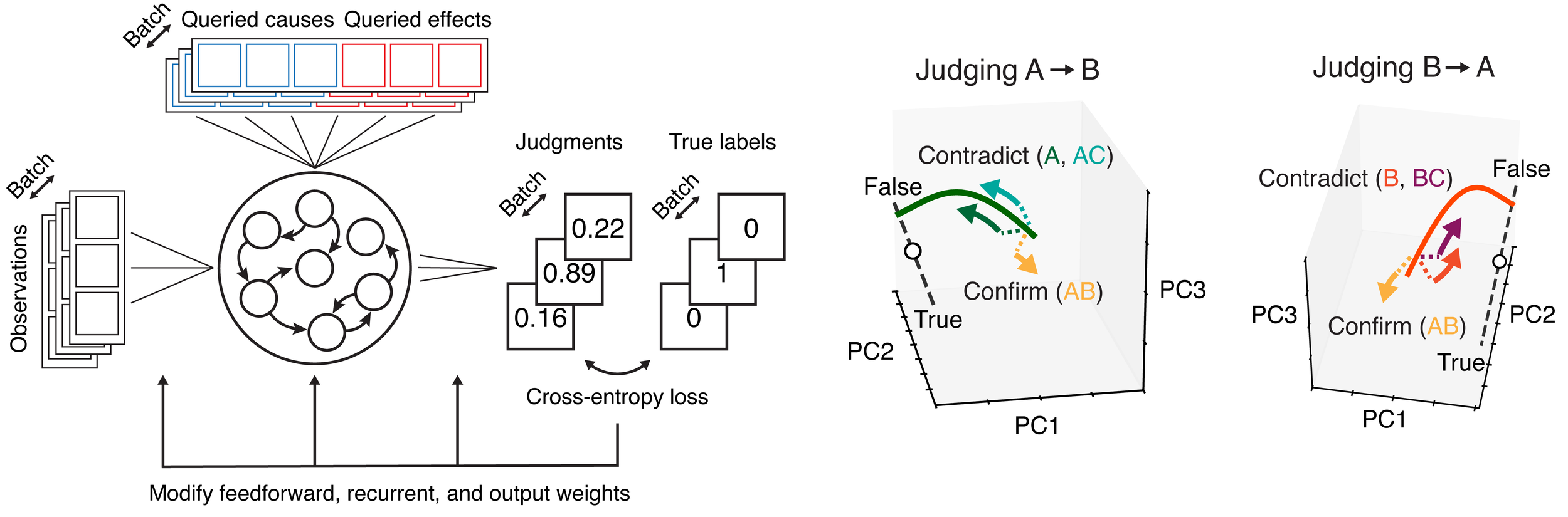
Reverse-engineering a computational model of causal structure learning (left) provides hypotheses about how neural circuits could judge causal relationships via the interaction of feedforward inputs (i.e. evidence) and recurrent dynamics (i.e. internal decision-making, right).
Triplett Lab
107-200A CHS
Department of Neurobiology
650 Charles Young Drive South
Room 107-200A CHS
Los Angeles, CA 90095-1763
Contact
[email protected]